What are best practices for manually writing new rules?
Last updated: November 26, 2025
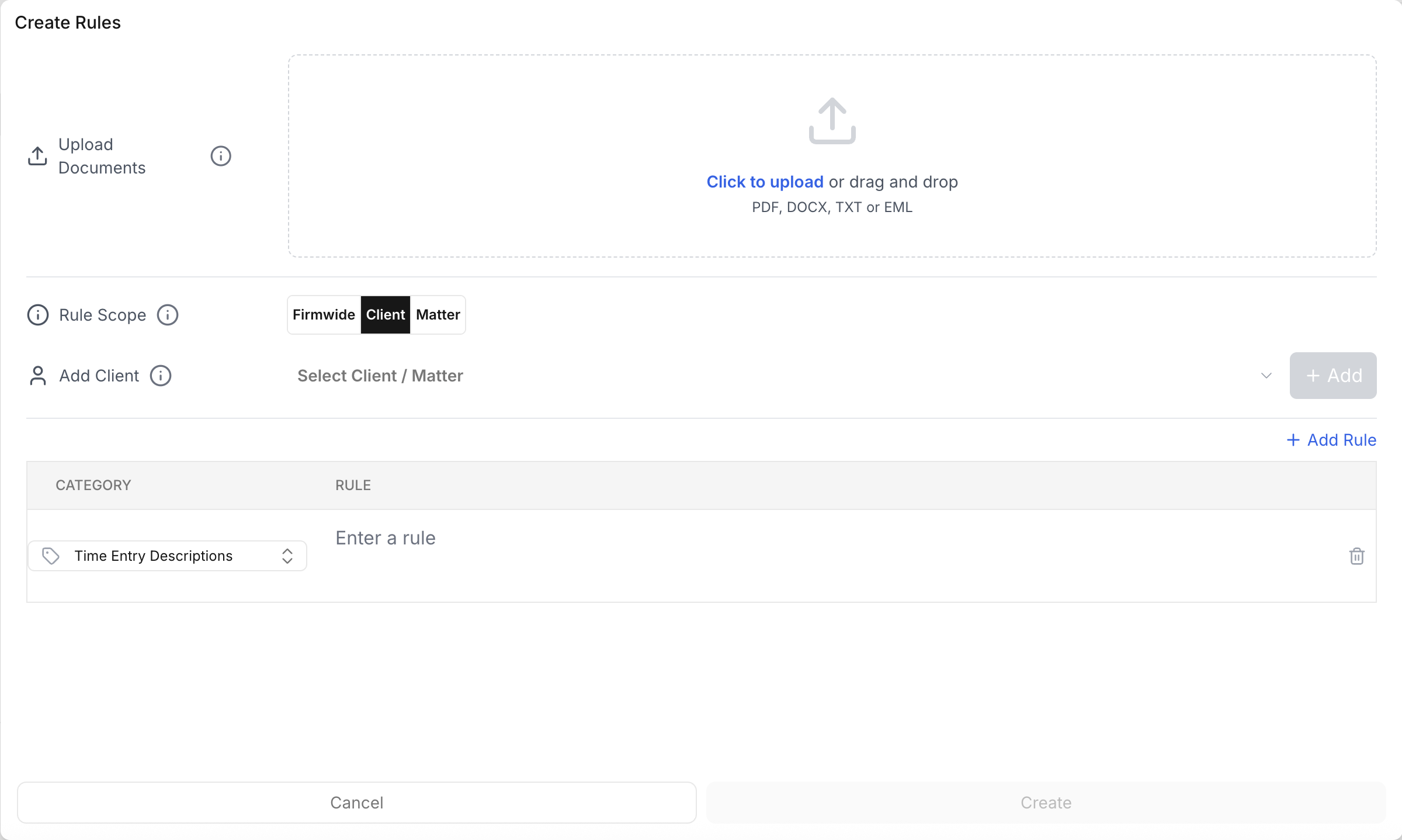
Administrators can create new rules by going to the PointOne web page and selecting "Add rules" in the top-right corner. Rules can be drafted manually in the text box, and then are finalized by pushing the "Create" button.
How to write effective rules
Imagine each rule as an instruction given by an attorney in isolation to their billing assistant. These instructions exist independently of one another.
Give PointOne context about when a rule would apply. For example, rather than write "Always use first name last initial," you should write "When a person is referenced, refer to them by first name last initial."
Examples of high-quality rules
"Avoid the use of the verbs 'schedule' and 'arrange' as these can be misconstrued as administrative tasks by clients."
"Narratives should be full sentences that end in a period."
"Do not describe activities as being done internally (ie, no 'internal meeting'; no 'internal conference'; no 'internal communications') and, instead, describe as analysis of the relevant topic or issue."
"Include a specific description of the subject researched on invoices unless attorney-client privilege or work product doctrine considerations dictate otherwise."
"When the task involves communications, the individuals communicated with should be specified, as should the purpose of the communication."
"Include a summary or attorney(s) and paralegal(s) hours including their rates and roles on every invoice."
"Provide a detailed description of each activity. Descriptions such as 'attention to project,' 'various conference calls,' or 'review strategy' are not acceptable."
Choosing the correct scope
Rules can apply firm-wide, at the client level, or at the matter level. The default setting is firm-wide rule application. Client and matter-level scoping will require the administrator to specify the relevant client or matters during the rule creation process.
Choosing the correct category
Use the "Forbidden billing terms" category for all rules which prohibit certain language. Most other rules that relate to narrative text will fall into the "Time entry descriptions" category.
Other categories are far less commonly used and exist for organizational and completeness purposes.